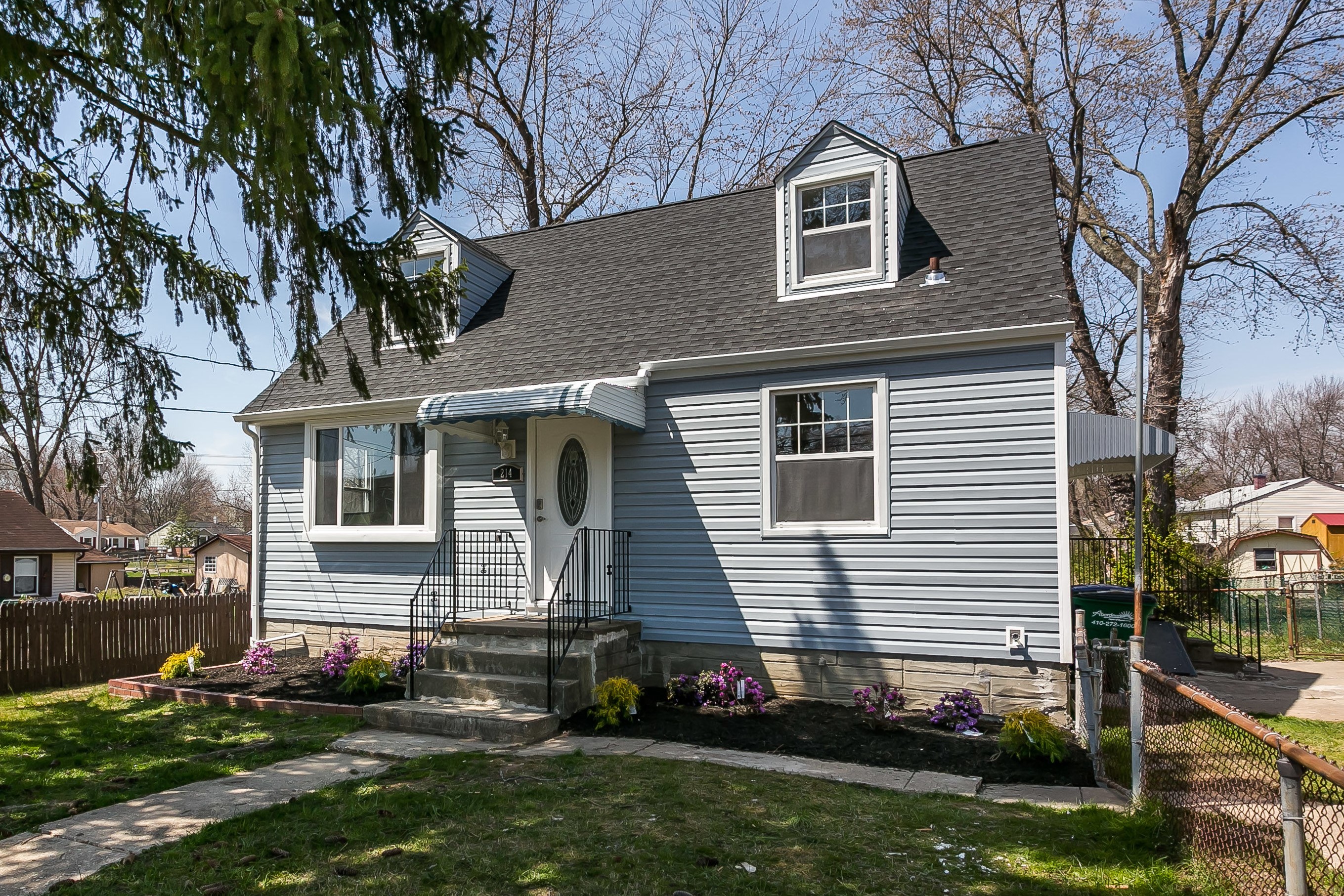
Real estate licensing may be a house flippers greatest investment
House flip in Aberdeen, Maryland purchased for $56,300 and later resold for $199,700 by an investor agent
Exactly how many house flippers are currently doing business in Maryland is unknown, but statistics have shown that the number has grown every year.
New real estate investors are inspired by countless house flipping shows on cable channels like HGTV, others may learn from a friend or relative who has done it before.
Experts cite the availability of
private or "hard"
money lending and the availability of non-traditional sources of flip financing
as one factor that has increased the number of house flippers doing business
today.
Is a real estate license required to be a house flipper? Some experts say yes. According to Maryland law, an individual must be licensed by the Maryland Real Estate Commission before providing real estate brokerage services. One of the many definitions in the Code of Maryland Regulations for providing brokerage services is "engaging regularly in a business of dealing in real estate or leases or options on real estate". While a real estate license may be required by law for a person who regularly buys, sells or rents their own properties, experts say the provision is not enforced.
In Maryland, a real estate license
can be easily obtained through a 60-hour course which can be done online or
in a classroom. There is a state mandated test to take and then the agent affiliates
with a licensed broker.
Some house flippers have decided to obtain a real estate license to avoid the ambiguities in the law, but also because it pays to do so.
There is sizable group of real
estate investors in Maryland who are known as "investor agents". An
"investor agent" holds a real estate license and can do everything
a licensed agent can do. They choose not to drive clients around or show homes
to other people. They hold a real estate license because of the many benefits
of doing so. Many of the benefits are economic.
Consider a real estate purchase.
Investors make a lot of them. In Maryland, it is legal for a person with a real
estate license to buy a property for themselves and collect a commission or
broker fee, so many investors agents do. Since the real estate commission paid
to a buyer's agent on a purchase can be significant, many of these investor
agents are defraying all of the costs of having and maintaining a real estate
license with one or two purchases.
Real
Estate Professionals, Inc. is a real estate brokerage in Maryland that encourages
real estate investors to get licensed. The broker, Robert Kaetzel, an investor
himself, created a division of the company that gives investors the opportunity
to get licensed and act as an investor agent at his brokerage.
One of an investor's largest expenses
when selling can be a real estate brokerage commission if the property is listed
for sale by an agent and most are. While there is no standard or established
fee to sell a home with a broker, a real estate brokerage might charge 5-7%
of the sales price to sell the property. That commission is routinely split
between the listing agent and the selling or buyer agent. At a traditional real
estate brokerage, the real estate broker might be entitled to a large percentage
of that fee, possibly up to fifty percent.
Kaetzel says that not all brokerages
work well for a real estate investor. At his brokerage, agents pay a small fee
each month. They also pay a transaction fee of either $195.00 or $395.00 when
they buy or sell a home. In return, the agents receive 100% commission on their
sales. Since the agents are earning 100% commission, they can keep the fees
they earn, or they are able to list their homes for sale with no listing agent
commission by not charging a listing fee. Since Kaetzel's agents are on a 100%
commission program, his agents are selling their own property through the multiple
listing service as agents for themselves and are saving the listing agent portion
of the commission typically charged to sell a property. On a large sale these
savings are significant.
Consider a $250,000 home resold by a house flipper. If the flipper paid a fee
of six percent of the sales price to sell their property, the commission would
be $15,000. If the house flipper had a real estate license with Kaetzel's brokerage,
Real Estate Professionals, Inc. they would pay a fee to a buyer agent only and
save the portion of the commission typically reserved for the listing agent.
The "investor agent" might save half or more of that $15,000 fee.
The savings can add up quickly and in a competitive market where investors are
scrambling to find houses these investor agents have a distinct advantage over
other investors who are not licensed.
There are other reasons that real
estate investors are getting licensed. Some say access to properties is a big
issue for them. Real estate investors can find getting into a property to be
a hassle if their agent isn't available to show a home right away. The best
priced houses sell quickly, and an investor agent may be able to look at a property
and submit an offer before another investor gets a return call from their agent.
Some houses that an investor might
purchase are lower priced and investors have reported that many agents don't
want to show these homes. Some agents have given access to vacant homes by giving
out the lockbox code to the investor rather than show the home. This activity
presents a legal issue for the agent and the investor if they are caught.
At some brokerages agents may be
banned from buying foreclosure properties if the brokerage has a fiduciary relationship
with that bank. Consider Department
of Housing and Urban Development (HUD) homes. In Maryland these houses are
listed by many different brokerages and HUD will not allow agents at these brokerages
or their related businesses to buy any HUD owned home even those not listed
with the agent's brokerage. At some large brokerages that could mean upset investor
agents who got a real estate license to buy these homes.
Many investor agents also have reported that they are able to create better
negotiations as they are negotiating for themselves and that this is a distinct
advantage over hiring an agent to negotiate for you especially if the agent
is new or inexperienced.
Having a real estate license can be a very smart investment for an investor especially if they buy or sell at least once or twice a year.